Nickel allergy and jewelry
Update log
- 2026-11-14: Published.
Quick answer
DermNet describes nickel allergy as one of the most common causes of contact allergic dermatitis, usually long-lasting, with earlobes, wrists and the lower abdomen the typical sites. Diagnosis is by patch test with a clinician. The EU sets numeric nickel release limits for jewelry; a label such as "nickel-free" is the maker's wording.

The short version
DermNet says nickel allergy is one of the most common causes of contact allergic dermatitis, and that it develops where nickel-containing metal touches the skin. For jewelry, that makes the practical questions ones about metal and contact: what the piece is made of, how long it touches skin, and whether the maker has published a nickel release result. This page lays out what the sources we read say about each. It is not medical advice. Diagnosis and management belong with a dermatologist or allergist.
What the sources say nickel allergy is
DermNet describes nickel dermatitis as eczema at the site of contact. The affected area can become intensely itchy and may turn red and blistered (acute dermatitis) or dry, thickened and pigmented (chronic dermatitis). It names the earlobes, wrists and lower abdomen as the most common sites, tied to earrings, watch straps and jeans studs respectively. Our pages on earrings, nickel-free earrings and watch bands cover those categories.
Two points from DermNet matter for buying decisions. First, once the allergy has developed, DermNet says it persists for many years and is often life-long, and it can develop at any age. Second, the degree varies: some people react to brief contact with a nickel-containing item, others only after years of wear. The page does not say how to predict which group someone belongs to. DermNet also notes the allergy is more common in women, “probably because they are more likely to have piercings than men, although this is changing”.
DermNet says diagnosis rests on clinical history and patch testing, where nickel sulphate hexahydrate is the test substance. We have nothing to add to that beyond sending readers to a clinician. It also says contact with nickel-containing metals should be avoided.
How common, and where it comes from
The only prevalence data we read are old. A 1987 study of 2,400 consecutive patients at eight clinics in five countries found nickel hypersensitivity in 176 (7.3%): 10.5% of women and 2.1% of men. Of the positives, 60.6% were schoolgirls or under 25. The abstract says 75% of cases were not occupationally acquired, and attributes them to costume jewelry (31.8%), wrist watches (23.3%) and metal clothing buckles including jeans buttons (3.4%). These are clinic patients in the 1980s, not a current population estimate, and customs of adornment have changed since.
A 1993 review looked at nickel, cobalt and chromium in personal care and household cleaning products. It concluded those products were a relatively minor source of contact, and that people sensitised to these metals have more significant daily contact from earrings, jewelry and metal objects. For jewelry shoppers, that is the abstract’s reason for focusing on metal items rather than trace amounts elsewhere.
What “nickel-free” can and cannot tell you
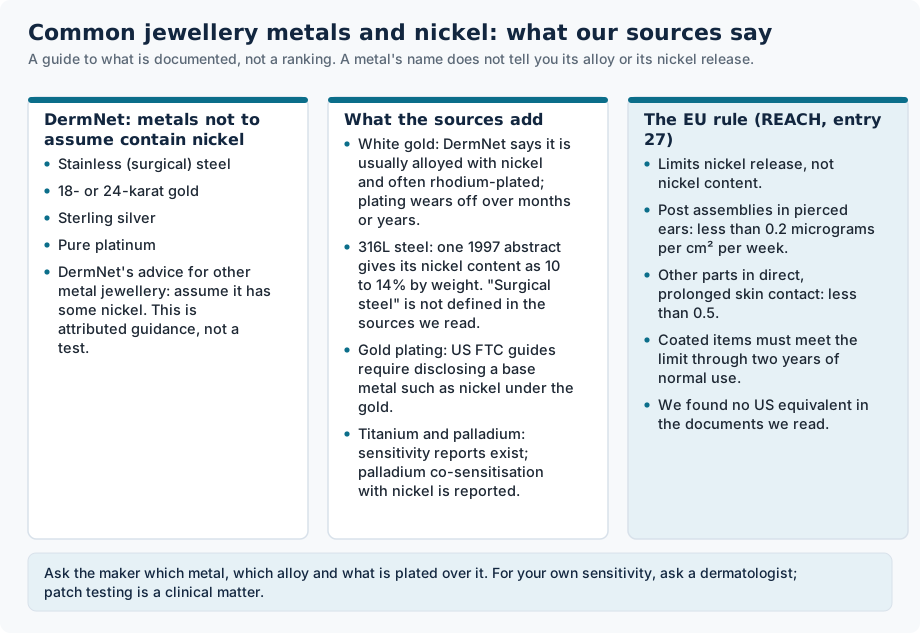
We found no source that defines “nickel-free” or similar wording as a jewelry label, so we treat it as the maker’s wording. The numeric benchmark we did find is in EU law. The consolidated REACH text (Annex XVII, entry 27) restricts nickel in:
- post assemblies inserted into pierced ears and other pierced parts of the body, unless the release rate is below 0.2 micrograms per square centimetre per week;
- articles whose parts come into direct and prolonged skin contact, if the release rate is above 0.5 micrograms per square centimetre per week;
- articles with a non-nickel coating, unless the coating keeps release at or below 0.5 for at least two years of normal use.
Our EU nickel directive guide goes through those limits. Two details matter here. The limits are about release over time, not a percentage of nickel in the alloy, so a maker’s metal name alone does not settle whether an item meets them. And the coating rule shows the regulator itself treats plating as something that can wear through; see our guides on gold plated, gold filled and vermeil and why jewelry turns skin green.
Meeting a limit is also not a promise of no reaction. A 1996 review abstract says the 0.5 level is one below which a minority of nickel-allergic subjects will react, and that it does not protect every nickel-sensitive individual. The same abstract says many nickel-containing alloys and jewelry items made from high-sulfur stainless steel exceeded that level at the time, and that manufacturers would have to change compositions to comply. That is a 1996 statement, and we did not read a current survey of compliance.
Checking a piece: metals and tests
The spot test guide covers home testing in detail. The one study figure to carry over: in a 2010 comparison of 96 earring components, the dimethylglyoxime (DMG) spot test had a sensitivity of 59.3% and specificity of 97.5% against the lab reference method. The authors call it high specificity but modest sensitivity, suitable for screening. A positive is informative; a negative leaves the question open.
On metals, our guides cover the usual questions: what surgical steel 316L means and stainless steel jewelry, gold karats and nickel, and titanium grades. Each rests on its own sources, and none of them lets us predict a reaction, or its absence, for a particular person.
Where to go from here
If you wear jewelry daily or for work, the workplace jewelry guide and the jewelry roundup are the next stops, and wedding rings have their own page because the piece is worn continuously. For new piercings, see earrings for piercing. The wider topic is collected under the nickel allergy concern hub.
One caution on diet: DermNet raises nickel in food only in connection with hand and foot eczema, says nickel is in most foods, and says a low-nickel diet is only rarely helpful. Whether that applies to anyone is a clinician’s call.
What we don't fully know
- We could not read the American Academy of Dermatology's nickel allergy page. The addresses we requested returned a "404 Error" page, so nothing on this page is attributed to the AAD and we make no claim about what it says.
- We read DermNet's nickel allergy page and PubMed abstracts, not full papers. We did not read a clinical guideline on managing nickel allergy, so we say nothing about treatment.
- We found no source that defines "nickel compliant", "nickel-free" or similar as jewelry labels, and no source on how common each wording is. Wording differences between such labels therefore cannot be explained here.
- The prevalence figure comes from a 1987 five-country clinic study. We did not find a current prevalence figure in the sources we read, and we do not know how it compares today.
- Our EU source is the consolidated REACH text of 1 January 2021. The passages we read give the release limits but we did not check which jewelry types fall under each limit, or whether the text has changed since.
- We found no US federal nickel release limit for jewelry in the sources we read, and we do not claim there is none. CPSC's jewelry FAQ, as we read it, does not mention nickel.
Frequently asked questions
What is nickel allergy?
DermNet says nickel allergy is one of the most common causes of contact allergic dermatitis, with dermatitis (eczema) developing where nickel-containing metal touches the skin.
Where on the body does it usually show?
DermNet names the earlobes (from earrings), the wrists (from a watch strap) and the lower abdomen (from a jeans stud). It says the areas can become intensely itchy and red or blistered (acute dermatitis), or dry, thickened and pigmented (chronic dermatitis).
Does it go away?
DermNet says that once nickel allergy has developed it persists for many years, often life-long, and that it may develop at any age.
Do all nickel-allergic people react to the same amount?
DermNet says the degree of allergy varies. Some people develop dermatitis from brief contact with nickel-containing items, while others break out only after many years of skin contact.
How is it diagnosed?
DermNet says by clinical history and by patch tests, in which baseline-series patients are tested with nickel sulphate hexahydrate. A clinician does this; a jewelry page cannot.
How common is it?
A 1987 study of 2,400 consecutive patients at 8 clinics in 5 countries found nickel hypersensitivity in 7.3% (10.5% of women and 2.1% of men). Most cases were not occupational; the study attributed 31.8% to costume jewelry and 23.3% to wrist watches. The figures are old and come from clinic patients, not the general population.
Do nickel limits for jewelry exist?
In the EU, the consolidated REACH text sets a nickel release limit of 0.5 micrograms per square centimetre per week for parts in direct and prolonged skin contact, and 0.2 for post assemblies inserted into pierced ears or other pierced parts of the body. Coated items must keep to the 0.5 limit for at least two years of normal use. See the EU directive guide for detail.
Does meeting the EU limit protect every nickel-allergic person?
A 1996 review abstract says the 0.5 level is one below which a minority of nickel-allergic subjects will react, and that it does not protect every nickel-sensitive individual. It also says many high-sulfur stainless steel jewelry items exceeded the level at the time. Ask a dermatologist about your own skin.
Do cosmetics and detergents matter for nickel allergy?
A 1993 review of consumer products concluded that the traces found in personal care and cleaning products were a relatively minor source of nickel compared with earrings, jewelry and metal objects. It recommended a maximum of 5 ppm for trace nickel in such products. That is a review's recommendation, not a regulation we found.
Does a low-nickel diet help?
DermNet says nickel is present in most foodstuffs, so it is not possible to avoid ingesting it, and that a low-nickel diet is only rarely helpful. DermNet raises this in connection with hand and foot eczema (pompholyx). Ask a clinician about diet.
Sources
- Nickel allergy (DermNet)Referenceaccessed 14 November 2026
- Regulation (EC) No 1907/2006 (REACH), consolidated text 01.01.2021, nickel restriction (Annex XVII entry 27), EUR-LexRegulatory list or noticeaccessed 14 November 2026
- Nickel dermatitis, review of nickel release limits (PubMed abstract, PMID 9007370, Contact Dermatitis 1996)Referenceaccessed 14 November 2026
- Sensitivity and specificity of the nickel spot (dimethylglyoxime) test (PubMed abstract, PMID 20536475, Contact Dermatitis 2010)Laboratory studyaccessed 14 November 2026
- Epidemiology of nickel allergy (PubMed abstract, PMID 2953549, Contact Dermatitis 1987)Observational studyaccessed 14 November 2026
- Nickel, cobalt and chromium in consumer products: a role in allergic contact dermatitis? (PubMed abstract, PMID 8428439, Contact Dermatitis 1993)Referenceaccessed 14 November 2026