Asthma and allergy friendly certification: what the program is
Update log
- 2026-11-14: Published.
Quick answer
The Asthma & Allergy Friendly mark is run by Allergy Standards Limited (ASL), with the Asthma and Allergy Foundation of America (AAFA) as US partner. Independent labs test products against a standard for each product type. The public pages give principles, not numeric limits.
Search for a certified bedding product and you will meet the phrase “Asthma & Allergy Friendly”. This page covers the program behind it: who runs it, what product types it certifies, what its published pages say it tests, and what they leave out. For how to read the mark on a label and check it, see our guide to reading a bedding allergy certification label; this page does not repeat those steps.
Everything below is attributed to the certifier’s own pages, which describe the program in its own favour. We read web pages, not the full standards, and we have not tested any product.
Who runs it
Two organisations appear. Allergy Standards Limited (ASL) says it created the Asthma & Allergy Friendly Certification Program “to scientifically test and identify consumer products that are more suitable for people with asthma and allergies”. Its pages say manufacturers that meet the eligibility criteria can use the mark and the phrase on products, packaging and marketing.
ASL’s pages say that in the USA its partner is the Asthma and Allergy Foundation of America (AAFA), a not-for-profit patient organisation. The program’s own site adds that AAFA’s Medical Scientific Council reviews each standard. AAFA’s 2026 press release on the program is about community asthma education; it quotes a program staff member and does not describe test methods. So the standards are ASL’s, with AAFA as the US partner and medical reviewer, as the program describes it. ASL also states that it has certified over 50 million products worldwide; we did not check that figure.
What it certifies
ASL’s certification page lists air purifiers, de-humidifiers, professional cleaning services, air filters, flooring and insulation, toys, bedding, humidifiers, vacuum cleaners, cleaning products, paint and washing machines. The US program site says it lists more than 200 certified products from more than 40 brands, and shows category counts on its home page: bedding 14, laundry 17, flooring 42, insulation 32, paint 21, air cleaners 17, air filters 14, vacuum cleaners 5, cleaning products 2 and whole-home air cleaners 2. Those counts are the site’s, on the day we read it.
So the mark is not a bedding label. Most of the listed products are floors, paint, insulation and air equipment, and bedding is one of the smaller categories on the finder. The mark on a pillow and the mark on a paint have different standards behind them.
How the standards are organised
Each product type has its own standard, numbered ASP and then a category and item number. The program site says there are 46 testing standards across 17 categories, developed with allergists, immunologists and environmental scientists, and that the standards are public. (The same page also refers to 15 product categories in its headline text; we do not know why the numbers differ.) It also says every product is tested by an accredited independent lab, not the manufacturer, and that ASL’s scientists review each result before certification.
What the bedding standards say
ASL’s standards page lists ten bedding items: pillows, pillow encasings, duvets and comforters, mattress encasings, flat sheets, mattress covers, mattresses, feather and down pillows, waterproof infant mattresses, and comforter or duvet covers. For most of them it lists the same principles:
- the item (or its outer encasing) must be an effective barrier to the passage of allergen;
- allergen that builds up on the outer surface must be removable by the recommended cleaning method at set intervals;
- the item must withstand that method at the stated frequency;
- the fabric must be breathable, for comfort;
- the item must not contain chemicals known to trigger allergic or irritant responses above certification levels.
The pages describe the assessment as “an algorithm of proprietary and recognized scientific techniques” aimed at likely exposure to allergenic and irritant materials at purchase and in use. A few items add their own tests:
- Mattress covers: surface allergen must be removable by washing in a domestic washing machine, the rate of house dust mite allergen accumulation under defined conditions must be determined, the cover must survive washing at the indicated frequency, and it must allow adequate water vapor transmission. See our page on mattress protectors for the product type.
- Feather and down pillows: the pillow must be an effective barrier to both allergen and the filling, and meet a down-proof method from the International Down and Feather Laboratory. The filling must not show evidence of significant mite or serum protein contamination, or of significant bacterial or fungal contamination. Compare pillows and down against down-alternative.
- Waterproof infant mattresses: also resistance to water penetration, water vapour resistance and an assessment of firmness.
- Mattresses: the mattress must incorporate a layer that acts as an effective barrier to allergen entering it.
Sheets and duvet covers need a certified barrier
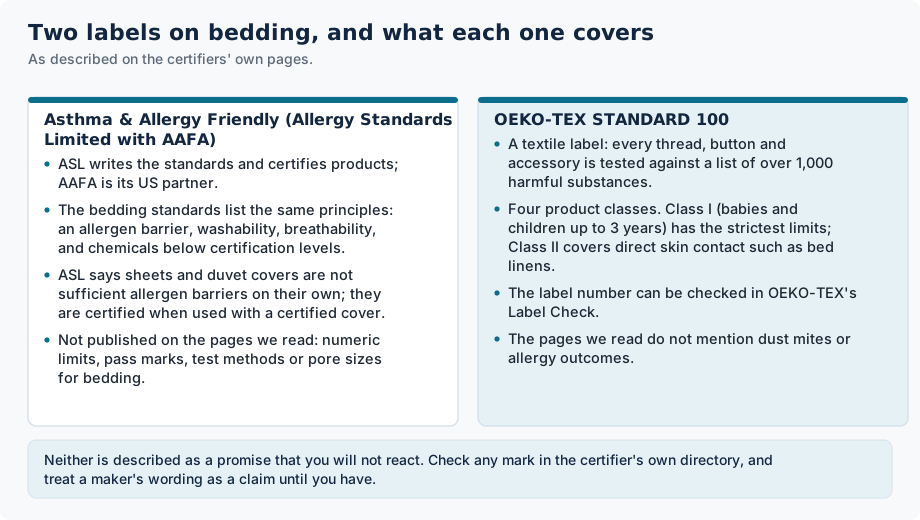
ASL’s sheet standard says sheets are not sufficient allergen barriers alone, but can be certified when used with a certified mattress encasement or mattress cover. The comforter and duvet cover addendum says the same: these items are not an encasement, consumers should not rely on them for encasement performance, and they are eligible when used with a certified duvet or comforter. A mark on sheets is therefore a statement about a pairing, according to ASL, not a claim that the sheet blocks allergen by itself. Likewise for duvets and comforters, the encasing is the part ASL describes as the barrier.
Laundry and washing machines
The detergent standard (ASP:09-04/101) is a different kind of test. ASL says it covers an allergen removal assessment, house dust mite removal and resurgence assessment, a review of constituents, VOC emission analysis, an evaluation of residual allergenic, irritant, banned or restricted chemicals on fabric after washing, and, where relevant, airborne particle levels during use. It tests what the detergent does to laundry, not only what is in the bottle. For laundry choices in general, see hypoallergenic laundry detergent and our laundry routine guide.
The washing machine standard lists a capability to reach a wash temperature of at least 55 C (131 F) and, for mite killing, prevention of group 1 mite antigen resurgence over a four-week incubation after washing items previously infested with live mites. AAFA’s own dust mite page gives a similar household figure, at least 130 F, for washing bedding.
Limits of what these pages show
- No numbers for bedding. The published bedding standards describe what is tested, not the pass marks, test methods or chemical limits. ASL says the limits for chemicals are kept under review in its toy standard; we found no limit values for bedding. This means “meets the standard” cannot be compared with another claim such as a pore size, which is why our page on dust-mite-proof cover pore size treats pore size separately.
- Certified is not the same as sufficient. AAFA’s dust mite page says even if you cover your mattress and pillows, dust mites can still live in your bedding, and recommends covers as one step among washing, vacuuming and keeping humidity between 30 and 50 percent. A cover is one part of a routine. See dust mites and bedding and the hypoallergenic bedroom guide.
- A different question from textile chemical labels. Whether a fabric has been tested for harmful substances is what OEKO-TEX STANDARD 100 addresses. Thread count is a separate matter again; see thread count and allergies.
- It describes products, not people. The wording is “more suitable” for people with asthma and allergies. For symptoms, triggers or treatment, ask a clinician or an allergy society.
Where to go next
For product types, see our pages on hypoallergenic bedding, mattresses and pillow protectors. To check whether a particular item carries the mark, use the program’s certified-products finder, filtering by category or brand, and treat a badge on a retail listing as the seller’s claim until the finder confirms it.
What we don't fully know
- ASL's bedding standards, as published on its website, list principles in words (an effective allergen barrier, removable surface allergen, durability to cleaning, breathability, chemicals below certification levels). They give no test methods, pass marks, pore sizes or chemical limit values. We cannot say how strict any threshold is.
- The program site says "15 categories" in one place and "46 testing standards across 17 categories" in another. We do not know the reason for the difference (for example, consumer categories against all standards), so we state both as written.
- We read page text only. We did not read the standards documents themselves, the accreditation of the partner labs, or how often products are retested or recertified.
- The certified-products finder loads its results in the page. We saw its filters and the category counts on the program home page, but we did not search it for any product, so we make no claim about which products or brands carry the mark in any category.
- Our earlier attempts to read allergystandards.com returned a gateway error (HTTP 502); on 2026-11-14 it loaded. The program site (asthmaandallergyfriendly.com) rejected a browser-style request with HTTP 406 and loaded with a plain request. We cannot say how the certification fees or contract terms work.
- We found no independent study in these sources of whether certified bedding changes symptoms. The pages we read describe testing of products, not health outcomes. For symptoms, ask a clinician.
- We have not tested any product ourselves.
Frequently asked questions
What is the Asthma & Allergy Friendly Certification Program?
ASL describes it as a program it created to scientifically test and identify consumer products that are more suitable for people with asthma and allergies. Products that meet the eligibility criteria can carry the mark and the phrase "Asthma & Allergy Friendly".
Who runs it?
ASL's pages say ASL develops the standards and certifies products, and that in the USA its partner is AAFA. The program site adds that AAFA's Medical Scientific Council reviews each standard. A 2026 AAFA release is signed by a program staff member, Leah McInerney, described as Client Success Lead.
Does the maker test its own product?
The program site says every product bearing the mark has been tested by an accredited independent lab, not the manufacturer, and that its scientists review every result before certification is granted. We did not check the labs or the accreditation.
What product types does it cover?
ASL's certification page lists air purifiers, de-humidifiers, professional cleaning services, air filters, flooring and insulation, toys, bedding, humidifiers, vacuum cleaners, cleaning products, paint and washing machines. The program site shows category counts that include bedding (14 certified products) and laundry (17) on the day we read it.
Which bedding items have a standard?
ASL lists standards for pillows, pillow encasings, duvets and comforters, mattress encasings, flat sheets, mattress covers, mattresses, feather and down pillows, waterproof infant mattresses, and comforter or duvet covers.
Does a certified sheet or duvet cover work as a dust-mite barrier on its own?
ASL says no. Its sheet and duvet-cover standards state that these items are not sufficient allergen barriers alone and are certified when used with a certified mattress encasing or cover (sheets) or a certified duvet or comforter (duvet covers).
Does it certify laundry detergent?
Yes. ASL lists a laundry detergent standard that includes allergen removal, house dust mite removal and resurgence assessment, constituent review, VOC emission analysis and an evaluation of residual allergenic, irritant, banned or restricted chemicals on fabric after washing. See our page on hypoallergenic laundry detergent.
Is it the same as "hypoallergenic"?
No. The program site says generic "hypoallergenic" claims have no legal definition and that the mark, by contrast, rests on independent testing to published standards. That is the program describing itself. See what hypoallergenic means.
Does a certified mattress cover mean I do not need to wash bedding?
AAFA's dust mite page says even with covers on a mattress and pillows, dust mites can still live in your bedding, and advises washing sheets and blankets weekly in water of at least 130 F. This is AAFA's general advice, not a statement about a certified product.
Does the mark mean I will not react?
The pages we read do not say that. ASL says certified products are "more suitable" for people with asthma and allergies. For your own triggers and treatment, ask a clinician or an allergy society.
Sources
- About the Certification (Allergy Standards Limited)Certification recordaccessed 14 November 2026
- The Science Behind the Certification (Allergy Standards Limited, certification standards list)Certification recordaccessed 14 November 2026
- Allergy Standards Limited (home page)Certification recordaccessed 14 November 2026
- Asthma & Allergy Friendly Certification Program (program home page)Certification recordaccessed 14 November 2026
- Find certified products (Asthma & Allergy Friendly Certification Program)Certification recordaccessed 14 November 2026
- Asthma & Allergy Friendly Certification Program teams with Chicago Asthma Consortium (AAFA press release, 2026)Certification recordaccessed 14 November 2026
- Dust Mite Allergy (Asthma and Allergy Foundation of America)Professional guidanceaccessed 14 November 2026