How to read a bedding allergy certification label
Update log
- 2026-11-14: Published.
Quick answer
Bedding marks fall into two groups. The Asthma & Allergy Friendly mark, run by AAFA, is a program for asthma and allergy suitability; OEKO-TEX STANDARD 100 is a textile label for harmful-substance testing. Check which one you see, and look the product up with the certifier.
Two different kinds of mark turn up on bedding, and they answer different questions. One comes from a program built around asthma and allergy suitability. The other is a textile label about harmful substances. Reading the label means working out which one you are looking at, what the certifier says it covers, and where you can confirm it.
Everything below is attributed to the certifiers’ own pages. They describe their programs; we have not tested products or audited either body, and we read web pages rather than the full standards.
Step 1: find the name of the certifier
A line such as “hypoallergenic” or “allergy friendly” names nobody. The Asthma & Allergy Friendly program’s own website says generic “hypoallergenic” claims have no legal definition (our page on what hypoallergenic means goes into that). So the first question is whether the label names a certifier, uses a recognisable mark, and gives a number or QR code. If it only has a word, you have the maker’s description and nothing to check it against.
Step 2: the Asthma & Allergy Friendly mark
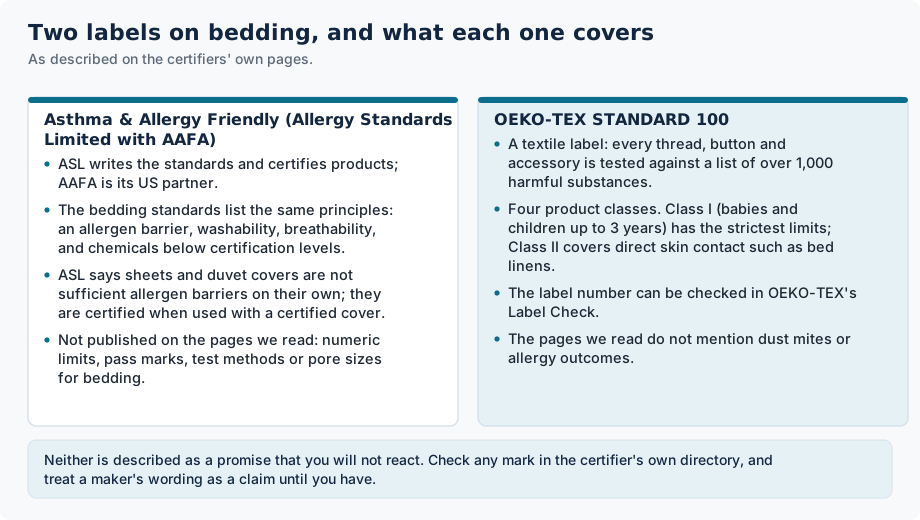
The program’s website describes it as a certification mark for products suitable for people with asthma and allergies. It says:
- products are tested by an accredited independent lab, not the manufacturer, and the program’s scientists review every result before certification is granted;
- it uses 46 testing standards across 17 categories, developed with allergists, immunologists and environmental scientists, and the standards are public;
- AAFA’s Medical Scientific Council reviews each standard.
A 2017 press release from AAFA and Allergy Standards Limited (ASL) describes the program as administered in the US by AAFA with ASL as its partner, and lists bedding among the certified product categories, alongside air cleaners, paints, vacuum cleaners and stuffed toys. The program’s site also lists bedding as one of its filter categories and says bedding is a major source of dust mites, with mattresses, pillows, sheets and blankets named.
What we could not establish: what the bedding standard actually measures. The pages we could read describe the program in general terms and do not give bedding test criteria or limits. If a label’s claim matters to you, for example whether a mark refers to a mite barrier cover or to a washable pillow, ask the certifier for the published standard for that category rather than assuming. Our guide to dust-mite-proof covers and pore size covers one specific thing a cover claim can mean. A separate page on the AAFA program is planned for the program as a whole; this page stays on label reading.
Where to check: the program has a certified-products page that you can filter by category or brand. We read that the page exists and what it says about itself, but we did not search it for any product, so we do not say what it lists.
Step 3: the OEKO-TEX STANDARD 100 label
OEKO-TEX describes STANDARD 100 as a label for textiles tested for harmful substances, from yarn to finished product. Its page says:
- every thread, button and accessory is tested against a list of over 1,000 harmful substances;
- limit values are reviewed at least once a year;
- the tests are based on the intended use of the textile, and stricter requirements apply the more intensive the skin contact and the more sensitive the skin.
It lists four product classes. Products for babies and children up to 3 years have the strictest requirements and limit values. Products with direct skin contact, such as bed linens, are another class. The remaining two are products without direct skin contact (jackets are the example given) and home textiles and decoration materials such as curtains. For bedding this means the class matters: a label on a sheet and a label on a curtain are not telling you the same thing about skin contact. Our explainer on OEKO-TEX STANDARD 100 goes through the standard in more depth.
The page we read does not mention dust mites, allergens or allergy outcomes. It is a statement about harmful substances in the material. It does say that the certified article is “harmless to human health”, which is OEKO-TEX’s own wording, and a reader should take it as a claim by the certifier about chemical testing, not as a result about allergy. The two marks do not substitute for each other.
Where to check: OEKO-TEX says you can scan the QR code on the label or enter the certificate number into its Label Check. The Label Check page says label numbers are case sensitive and links to withdrawn certificates and labels. It also points to an online directory of certified products, manufacturers and brands. We read that these pages exist; we did not look up any particular product.
Step 4: check the claim against the product, not the page it sits on
Retailer and maker pages often show a mark in a gallery of badges. A badge on a listing is the seller’s claim until you confirm it with the certifier. Useful questions:
- Does the mark name the certifier and show a number or QR code?
- Does the certifier’s own lookup show the same product name or the product class you are buying?
- Does the certificate cover this item (a pillow, a sheet, a cover), or only a component or another item from the same brand?
- Is the certificate current? OEKO-TEX says certificates are issued for one year, and its Label Check lists withdrawn ones.
We could not verify what each certifier’s lookup returns for a given product, so these are things to confirm rather than things we confirmed.
Where the page goes next
If you are choosing between product types, our pages on hypoallergenic bedding, sheets, pillows, mattress protectors, duvets and comforters cover what we could verify about specific products. For why bedding matters for allergy at all, see dust mites and bedding allergy and, for a common misunderstanding, thread count and allergies. For symptoms, diagnosis or what to do about them, ask a clinician or an allergy society; a label cannot answer that.
What we don't fully know
- We could not read the website of Allergy Standards Limited (allergystandards.com); it returned a gateway error (HTTP 502) on several attempts on 2026-11-14. Everything we say about ASL comes from AAFA's own pages. We do not state ASL's test methods.
- The AAFA program pages we could read describe the program in general terms and list bedding among certified categories. They do not set out what a bedding standard measures (for example, mite or allergen barrier performance or limits). We do not say what a bedding mark covers beyond what those pages state. Ask the certifier for the published standard.
- We read the certified-products page of the program, but it is a search tool that loads results on the page. We did not search it for any named bedding product, so we make no claim about which products are listed.
- We did not check how a given retailer or maker uses a mark on its own product page. A mark on a listing is a claim by the seller until you confirm it with the certifier.
- The OEKO-TEX pages we read describe the STANDARD 100 label and its product classes. They do not describe testing for allergens such as dust mites, and we found no OEKO-TEX statement on allergy outcomes. We read the standard's public page, not the full criteria catalogue or limit values.
- We did not test any product ourselves, and we read web pages, not the full certification standards.
Frequently asked questions
Is "hypoallergenic" on a label the same as being allergy certified?
No. The Asthma & Allergy Friendly program page says generic "hypoallergenic" claims have no legal definition and describes its own mark as the result of independent testing against its standards. Those are the program's own words about itself. See our guide on what hypoallergenic means.
What does the Asthma & Allergy Friendly mark show?
The program's website says every product bearing the mark has been tested by an accredited independent lab rather than the manufacturer, that its scientists review the results, and that it uses 46 testing standards across 17 categories. It also says AAFA's Medical Scientific Council reviews each standard. A 2017 AAFA and Allergy Standards Limited press release says the program tests and certifies products to show their suitability for people with asthma and allergies and lists bedding among certified categories.
Who runs the Asthma & Allergy Friendly program?
A 2017 press release describes it as an independent program administered in the US by AAFA with its partner Allergy Standards Limited (ASL). Its current website describes it as the Asthma & Allergy Friendly Certification Program. We could not read ASL's own site.
What does OEKO-TEX STANDARD 100 cover?
OEKO-TEX describes it as a label for textiles tested for harmful substances, from yarn to finished product. It says every thread, button and accessory is tested against a list of over 1,000 harmful substances, and that limit values are reviewed at least once a year.
Does OEKO-TEX STANDARD 100 test for dust mites or allergy outcomes?
The OEKO-TEX page we read describes testing for harmful substances and does not mention dust mites or allergy results. See our explainer on what OEKO-TEX STANDARD 100 means for the standard on its own.
What are the OEKO-TEX product classes and where do sheets fit?
OEKO-TEX lists four classes with stricter requirements for more intensive skin contact. Products for babies and children up to 3 years have the strictest requirements. Products with direct skin contact include bed linens. The others are products without direct skin contact, such as jackets, and home textiles and decoration materials, such as curtains.
How do I check an OEKO-TEX label?
OEKO-TEX says you can scan the QR code on the label or enter the certificate number in its Label Check, and its Label Check page says label numbers are case sensitive. The page also links to a list of withdrawn certificates and labels.
How do I check an Asthma & Allergy Friendly mark?
The program runs a certified-products page that you can filter by category or brand, and bedding is one of its categories. We did not search it for particular products, so we cannot say what any given product's entry shows.
Does a certification mean I will not react?
Neither certifier is quoted here as promising that. For individual reactions or asthma management, speak to a clinician or an allergy society.
Sources
- Asthma & Allergy Friendly Certification Program (home page, asthmaandallergyfriendly.com)Certification recordaccessed 14 November 2026
- Find certified products (Asthma & Allergy Friendly Certification Program)Certification recordaccessed 14 November 2026
- Consumers with Pet Allergy Have a New Option for Dander Control (AAFA and Allergy Standards Limited press release, 2017, with program description)Certification recordaccessed 14 November 2026
- Asthma & Allergy Friendly Certification Program teams with Chicago Asthma Consortium (AAFA press release, 2026)Certification recordaccessed 14 November 2026
- OEKO-TEX STANDARD 100Technical standardaccessed 14 November 2026
- OEKO-TEX Label CheckTechnical standardaccessed 14 November 2026