What does OEKO-TEX STANDARD 100 mean?
Update log
- 2026-11-14: Published.
Quick answer
OEKO-TEX describes STANDARD 100 as a label for textiles tested against a list of over 1,000 harmful substances, with stricter limits where skin contact is more intense. The pages read say nothing about allergy outcomes or dust mites.

The short version
OEKO-TEX describes STANDARD 100 as “a label for textiles tested for harmful substances”, covering the item from yarn to finished product. It is a textile chemistry label. The pages read describe nothing about allergens, dust mites or whether anyone reacts to the finished item. This page covers what the standard says it tests, how the four classes work and where the public pages stop. For reading label marks on bedding more generally, see how to read a bedding allergy certification label.
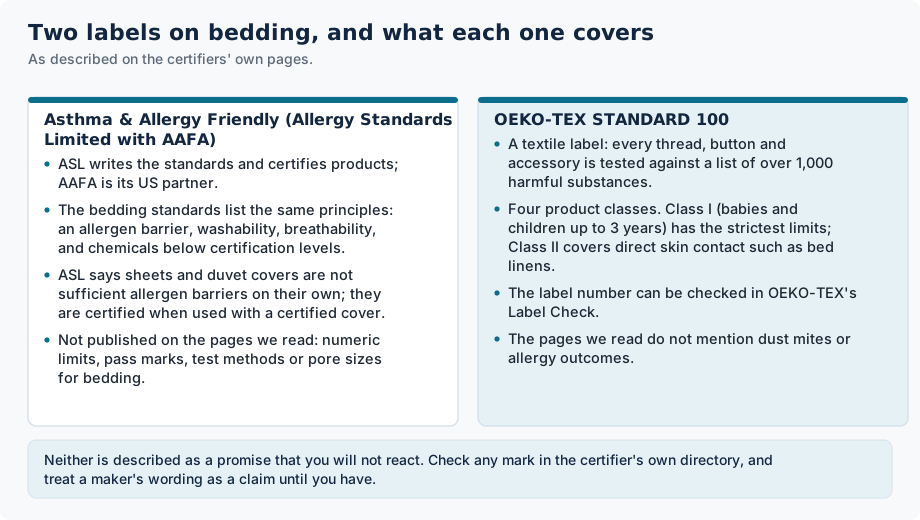
What OEKO-TEX says it tests
According to OEKO-TEX’s STANDARD 100 page (read 2026-11-14), the points it makes about the standard are these:
- Every item bearing the label is certified, per OEKO-TEX, as having passed tests for the presence of harmful substances.
- Every thread, button and accessory is tested against a list of over 1,000 harmful substances.
- Limit values are reviewed at least once a year.
- The tests are described as based on globally standardised criteria and the certification as compliant with international requirements and regulations, with the page naming REACH annexes XVII and XIV, CPSIA and the ECHA SVHC candidate list.
- It says the certified article is “harmless to human health”. That is the certifier’s own claim about its label.
The page gives the number of substances but not the list, the limit values or the lab methods. Those sit in the standard’s documents (the page offers a standard, a factsheet and a brochure for download), which were not read here. So this page cannot tell you what any limit is, or which substances are on the list.
The four product classes
OEKO-TEX says the laboratory tests “are based on the intended use of the textiles and materials. Stricter human ecology requirements must be met, the more intensive the skin contact and the more sensitive the skin is.” It names four classes:
| Class | OEKO-TEX’s description |
|---|---|
| I | Products for babies and children up to 3 years, such as diapers. “This product class has the strictest requirements and limit values.” |
| II | Products with direct skin contact, such as bed linens. |
| III | Products without direct skin contact, such as jackets. |
| IV | Home textiles and other decoration materials, such as curtains. |
Two practical points follow from the page itself. Sheets and pillowcases sit in Class II by OEKO-TEX’s own example, so a Class II label on a sheet is the expected one rather than a weaker result. And a label on a curtain or a rug is a Class IV label, with different requirements from one on baby bedding. If a maker states a class, it is worth checking it against the certificate. The Label Check is the place OEKO-TEX points to for that.
How the label is obtained
OEKO-TEX lists these steps: application with a material sample, verification, definition of test and measurement criteria and testing of the sample, an on-site inspection and evaluation of the company, a detailed test report, and a certificate issued for one year. It adds that the system is modular. If all components have been successfully tested to STANDARD 100, the finished-product testing costs are waived. A finished-product label can therefore rest on component tests.
Checking a label
OEKO-TEX says you can scan the QR code on a label or enter the certificate number in its Label Check. The Label Check page says label numbers are case sensitive, tells you to contact OEKO-TEX if no result appears, and links to a list of withdrawn certificates and labels. The page does not say what a result displays, and that is only visible after entering a number. This page did not enter any.
What the pages do not say
None of OEKO-TEX’s pages read for this guide mention allergy, allergic reactions, dust mites or sensitive-skin outcomes as something the label measures. The class wording refers to skin sensitivity only as a reason for stricter limit values. So the sourced position is narrow: the label is about harmful-substance testing of textile materials, by class. Whether a given certified item suits someone with an allergy is a clinical question, and no source read for this page answers it.
That separates it from marks that describe themselves in allergy terms. The Asthma & Allergy Friendly program is a different kind of mark with a different stated purpose. What causes the dust-mite problem in bedding is a separate matter, and the standard as described does not address it. The wider caveat that “hypoallergenic” is not defined in law is in what hypoallergenic means.
Where the label shows up on this site’s records
These are statements from maker pages, read on the dates shown, and not checked in the Label Check. Each is a maker’s claim.
- The Parachute Percale Sheet Set record (evidence level maker-browser, 2026-11-13) quotes the page as “OEKO-TEX STANDARD 100 16.HUS.93300 Hohenstein HTTI”.
- The Buffy Cloud Pillow record (maker-browser, 2026-11-13) quotes the maker as saying the pillow is certified to STANDARD 100 Class I, calling it the strictest class. The class description in that sentence is the maker’s wording.
- The Coop Home Goods Ultra-Tech Waterproof Mattress Protector record (maker-browser, 2026-11-13) records the maker’s statement that every component is STANDARD 100 certified, with no certificate number shown on the page.
- The Coop Home Goods Original Adjustable Pillow record (maker-browser, 2026-11-13) notes that the page lists GREENGUARD GOLD and CertiPUR-US, not OEKO-TEX.
Where a number is given, it is the first thing to enter in the Label Check. Where none is shown, the claim is a line on a web page until you confirm it. For the categories these records sit in, see our pages on sheets, pillows, mattress protectors, comforters and bedding in general. A note on thread count and allergies covers another spec that often sits near the label, and nursery bedding is where Class I matters most. The whole-room view is in the hypoallergenic bedroom guide.
How to use this
Treat a STANDARD 100 label as one piece of information about the chemistry of a textile. Note the class, check the number with OEKO-TEX, and look elsewhere for anything about mites or allergens. If you have a diagnosed allergy or a skin condition, ask a clinician which materials suit you.
What we don't fully know
- OEKO-TEX's public STANDARD 100 page gives the number of substances (over 1,000) but not the list, the limit values or the test methods. Those are in the full standard and criteria documents, which this page did not read. No limit or substance is stated here.
- The OEKO-TEX Label Check page is a form that returns a result for a number entered. It cannot be read as a static page, so no individual certificate was checked.
- The pages read contain no statement about allergic reactions, dust mites or skin-sensitivity outcomes. The absence is reported, not interpreted. For allergy questions OEKO-TEX itself would be the party to ask.
- OEKO-TEX's page claims the certified article is "harmless to human health". This page reports it as the certifier's own claim and did not find an independent study evaluating that claim.
- Several bedding records on this site cite a STANDARD 100 certificate number. These were quoted from maker pages on the dates stated, and none was entered into the Label Check.
Frequently asked questions
What does OEKO-TEX STANDARD 100 test for?
OEKO-TEX describes it as a label for textiles tested for harmful substances, from yarn to finished product. It says every thread, button and accessory is tested against a list of over 1,000 harmful substances. It says it reviews its limit values at least once a year.
What are the four product classes?
According to OEKO-TEX, Class I is products for babies and children up to 3 years, such as diapers, with the strictest requirements and limit values. Class II is products with direct skin contact, such as bed linens. Class III is products without direct skin contact, such as jackets. Class IV is home textiles and other decoration materials, such as curtains.
Why does the class matter?
OEKO-TEX says the tests are based on the intended use of the textile. The more intensive the skin contact and the more sensitive the skin, the stricter the requirements. A Class IV label and a Class I label therefore do not describe the same limits.
Does STANDARD 100 mean a product is hypoallergenic?
The OEKO-TEX pages read do not use the word hypoallergenic or describe allergy testing. "Hypoallergenic" has no legal definition; see the guide on what hypoallergenic means. The standard is described as testing for harmful substances.
Does it mean a pillow or sheet is mite-proof?
The pages read do not mention dust mites. See the guide on dust mites and bedding allergy for what causes the reaction.
How do I check a label?
OEKO-TEX says you can scan the QR code on the label or enter the certificate number in its Label Check. It states label numbers are case sensitive and lists a section for withdrawn certificates and labels.
How long does a certificate last?
OEKO-TEX's description of the certification path ends with a certificate issued for one year.
Is the label the same on every product?
OEKO-TEX says the system is modular, so costs are spread across production steps and finished-product testing costs are waived if all components have been successfully tested to STANDARD 100. A label can therefore rest on tested components.
Sources
- OEKO-TEX STANDARD 100 (OEKO-TEX Association)Certification recordaccessed 14 November 2026
- OEKO-TEX Label Check (OEKO-TEX Association)Certification recordaccessed 14 November 2026
- OEKO-TEX Labelling Guide (OEKO-TEX Association)Certification recordaccessed 14 November 2026