Pillow fill types compared
Update log
- 2026-11-14: Published.
Quick answer
No source we read ranks down, feather, polyester, foam, latex, wool or buckwheat for allergy. The one direct fill comparison found more mite allergen on synthetic than feather pillows after a year, so the cover and washing routine matter as much as the fill.

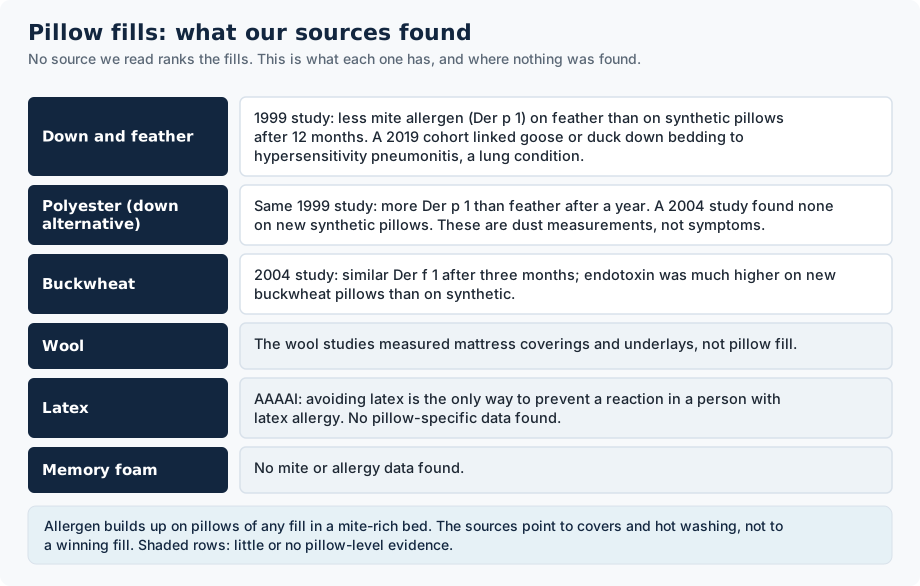
Short answer. The sources we read do not name a winning fill. They show that mite allergen builds up on pillows of any fill that sits in a mite-rich bed, that a few fills have specific, different concerns, and that for several fills (memory foam, latex, wool pillows) there is no readable pillow-level data. Where a comparison point has no source, this page says so rather than guessing. Nothing here is medical advice; allergy questions belong with a clinician or allergist.
What the evidence covers
Dust mites are the usual reason people compare pillow fills. NIEHS says mites live in mattresses and bedding, feed on shed skin, and “cannot be completely eliminated” however clean the home is; it advises humidity at or below 50 percent, allergen-impermeable covers on mattresses and pillows, and weekly hot washing of bedding. For the wider background see why dust mites live in bedding and how mite-proof cover pore size works.
Down and feather versus synthetic
A 1999 study (PMID 10051721) put pairs of new synthetic and feather pillows on 12 beds and measured the mite allergen Der p 1 for 12 months. After a year, synthetic pillows held 19.28 micrograms per gram of dust (95% confidence interval 9.76 to 38.07) and feather pillows 6.45 (2.96 to 14.05). The authors report that synthetic pillows accumulate Der p 1 faster, and that pillow levels followed the Der p 1 concentration of the mattress where they were placed (r = 0.72). They also refer to an earlier study from the same group with the same direction of result. This is a small study from 1999, and it does not test how washing or covers change the picture.
Down has a separate issue unrelated to mites. A 2019 cohort (PMID 31042573) found that 32 of 80 patients with hypersensitivity pneumonitis used goose or duck down bedding, and 12 of those 32 went into remission or stopped progressing after avoiding it. That is a lung condition rather than a typical pillow allergy, and the abstract does not say how common it is among ordinary down users. A 2019 laboratory paper (PMID 30901881) says down and feather materials can become more allergenic when contaminated with microorganisms, and that washing the material appropriately reduced bacteria counts. It tested raw materials, not finished pillows. For the comforter side of this choice see down versus down-alternative pillows.
Down-alternative (polyester) fills
The only direct data we read on synthetic pillows is the 1999 result above: more Der p 1 after a year than feather. A 2004 Korean study (PMID 15308838) found no Der f 1 on new synthetic pillows and a geometric mean of 1.08 micrograms per gram after three months. We found no source on washability of polyester fill beyond the general advice to wash bedding hot.
Memory foam and latex
We found no readable study of mite allergen on memory foam or latex pillows; the table below marks this as unknown. For latex, the AAAAI describes latex as sap from rubber trees and says natural rubber latex is often found in gloves, condoms, balloons, rubber bands, erasers and toys. It says the only way to prevent a reaction in a person with latex allergy is to avoid latex, and that diagnosis belongs with an allergist. Its page does not address pillows, mattresses or how much protein survives in a finished latex product, so we cannot say whether a given latex pillow matters for a latex-allergic person. See the latex versus memory foam pillow comparison and the mattress topper roundup for related products.
Wool
The Melbourne mite study (PMID 9058687) measured mite allergen on mattress coverings, not pillows. Surface Der p 1 was 116 micrograms per gram on sheepskin, 113 on wool, 19 on cotton and 0.4 on impermeable encasements. A New Zealand survey (PMID 9678840) found bedding levels higher in beds with wool underlays, kapok or inner-sprung mattresses. Both are about bedding layers other than pillow fill and do not show that a wool pillow behaves the same way. Wool allergy and skin reactions are covered in whether wool is hypoallergenic.
Buckwheat
On the 2004 Korean study (PMID 15308838), new buckwheat pillows carried much more endotoxin than new synthetic ones (60,950 versus 4,887 EU/g, p<0.001), while mite allergen was absent when new and similar after three months (1.16 versus 1.08 micrograms per gram). The authors tie endotoxin to asthma severity in atopic asthmatics. That is the full extent of what we read on buckwheat.
Comparison at a glance
| Fill | Mite allergen data read | Other point from sources read | Washability source |
|---|---|---|---|
| Down and feather | Feather: lower Der p 1 than synthetic at 12 months (one small 1999 study) | Hypersensitivity pneumonitis case series; microbial contamination paper | None found |
| Down-alternative polyester | Higher Der p 1 than feather at 12 months; 1.08 micrograms per gram at 3 months (different study) | None found beyond the above | None found |
| Memory foam | None found | None found | None found |
| Latex | None found | AAAAI latex allergy overview; nothing pillow-specific | None found |
| Wool | Mattress coverings only, not pillows | Higher bedding levels with wool underlays (NZ survey) | None found |
| Buckwheat | No allergen when new; similar to synthetic at 3 months | Higher endotoxin when new | None found |
Products on this site, by fill
We have not tested products. These are the pillow records on this site, with the evidence level stated on each; they cover only polyester down-alternative and a foam-and-microfiber blend, and none is shown by the sources above to be better for allergy.
- Boll & Branch Down Alternative Pillow: PrimaLoft down-alternative fiber fill with an organic cotton shell. Per the maker’s page, read 13 November 2026, the maker calls it “A hypoallergenic PrimaLoft® pillow with a 100% organic cotton shell” (the maker’s claim, not a defined standard) and cites OEKO-TEX STANDARD 100 and OCS statements.
- Brooklinen Down Alternative Pillow: recycled polyester microgel fill with a cotton sateen shell. Captured from the maker’s page in a browser on 13 November 2026; the maker calls the fill “hypoallergenic” (maker’s claim). No Amazon listing found; the card links to the maker’s site.
- Coop Home Goods Original Adjustable Pillow: cross-cut memory foam and microfiber blend. Captured from the maker’s page in a browser on 13 November 2026; the maker calls the blend “hypoallergenic” (maker’s claim) and cites GREENGUARD GOLD and CertiPUR-US, not OEKO-TEX.
- Buffy Cloud Pillow: recycled PET fill with a TENCEL lyocell shell. Meets our criteria; the maker doesn’t call it hypoallergenic. Captured in a browser on 13 November 2026; it cites OEKO-TEX STANDARD 100 Class I.
- Parachute Down Alternative Pillow: recycled polyester fill with a cotton sateen shell. Meets our criteria; the maker doesn’t call it hypoallergenic. Captured in a browser on 13 November 2026; it cites an OEKO-TEX STANDARD 100 certificate number.
The full list, with the Utopia pillows, is in hypoallergenic pillows.
Applying this
Choose a fill for comfort and for the specific concern you have (latex allergy, down sensitivity), then handle mites with the measures the health bodies describe: an allergen-impermeable pillow protector, weekly hot washing of sheets and bedding, and humidity control. Our bedding overview and bedroom guide put these together. For what certification labels do and do not show, see OEKO-TEX Standard 100 explained and allergy-certified bedding labels. The wording on makers’ pages is covered in what hypoallergenic means.
What we don't fully know
- We found no study that compares all seven fills in one setting. The comparisons below come from separate studies of different designs, so we do not rank the fills.
- We found no source on mite allergen levels in memory foam or latex pillows. We say nothing about how they compare.
- The wool results we read are for mattress coverings and underlays, not pillow fill. We found no pillow-fill study for wool.
- We found no source on pillow washability by fill type. The five makers' records on this site do not state washing instructions, so we do not say which pillows can be machine washed.
- The AAAAI latex page does not mention pillows, mattresses or foam. We found no source saying how much natural rubber latex protein remains in a finished latex pillow, so that is unknown.
- The mite studies are from 1997 to 2004 and measure allergen in dust samples, not symptoms. Pillow construction and materials may have changed since.
- We read abstracts, not full papers, and did not read the full AAAAI page beyond its overview and management sections. Product facts are limited to the records dated 13 November 2026.
Frequently asked questions
Is feather or synthetic fill better for dust mite allergy?
The sources we read do not say either is better. A 1999 study (PMID 10051721) placed new synthetic and feather pillows on 12 beds and measured Der p 1 after 12 months. Synthetic pillows held 19.28 micrograms per gram and feather pillows 6.45. The authors also found pillow levels correlated with the mattress's starting level (r = 0.72).
Are buckwheat pillows worse for allergies?
A 2004 Korean study (PMID 15308838) found no Der f 1 on new buckwheat or synthetic pillows and similar levels after three months, but endotoxin was much higher on new buckwheat pillows (60,950 EU/g against 4,887 EU/g for synthetic). The authors link endotoxin to asthma severity in atopic asthmatics; for medical questions ask a clinician.
Do latex pillows contain latex allergen?
We did not find a source that answers this for pillows. The AAAAI describes latex as sap from rubber trees and lists gloves, condoms, balloons, rubber bands, erasers and toys as common natural rubber latex items. Anyone with a latex allergy should ask an allergist.
Does a hypoallergenic fill exist?
The word has no legal definition, so a maker's use of it describes a claim, not a tested standard. See what hypoallergenic means for how we treat it.
Does the fill matter if I use a pillow cover?
NIEHS advises encasing mattresses and pillows in dust-proof or allergen-impermeable covers, and AAFA says covers need pores too small for mites and their waste to pass. These recommendations are not tied to a fill type.
Can I wash my pillow to remove mites?
NIEHS says to wash bedding weekly in hot water at 130 to 140 degrees Fahrenheit, and that non-washable bedding can be frozen overnight. Its page does not say whether a given pillow tolerates that heat; check the maker's care label.
Sources
- House dust mite allergen (Der p 1) accumulation on new synthetic and feather pillows (PubMed abstract, PMID 10051721, Clin Exp Allergy 1999)Observational studyaccessed 14 November 2026
- Endotoxin and house dust mite allergen levels on synthetic and buckwheat pillows (PubMed abstract, PMID 15308838, J Korean Med Sci 2004)Observational studyaccessed 14 November 2026
- The Melbourne house dust mite study: eliminating house dust mites in the domestic environment (PubMed abstract, PMID 9058687, J Allergy Clin Immunol 1997)Observational studyaccessed 14 November 2026
- Determinants of house dust mite allergen in homes in Wellington, New Zealand (PubMed abstract, PMID 9678840, Clin Exp Allergy 1997)Observational studyaccessed 14 November 2026
- Frequency of goose and duck down causation of hypersensitivity pneumonitis within an 80-patient cohort (PubMed abstract, PMID 31042573, Ann Allergy Asthma Immunol 2019)Observational studyaccessed 14 November 2026
- An Integrative Evaluation Method for the Biological Safety of Down and Feather Materials (PubMed abstract, PMID 30901881, Int J Mol Sci 2019)Laboratory studyaccessed 14 November 2026
- Latex Allergy, American Academy of Allergy, Asthma and ImmunologyProfessional guidanceaccessed 14 November 2026
- Dust Mites and Cockroaches, National Institute of Environmental Health SciencesProfessional guidanceaccessed 14 November 2026
- Dust Mite Allergy, Asthma and Allergy Foundation of AmericaProfessional guidanceaccessed 14 November 2026
- Boll & Branch Down Alternative Pillow, maker pageManufacturer dataaccessed 13 November 2026
- Brooklinen Down Alternative Pillow, maker page (browser-captured)Manufacturer dataaccessed 13 November 2026
- Coop Home Goods Original Adjustable Pillow, maker page (browser-captured)Manufacturer dataaccessed 13 November 2026
- Buffy Cloud Pillow, maker page (browser-captured)Manufacturer dataaccessed 13 November 2026
- Parachute Down Alternative Pillow, maker page (browser-captured)Manufacturer dataaccessed 13 November 2026